Let’s be real: getting a rent increase notice can be stressful. At the same time, there’s a logic behind it—rules, timelines, and concrete options to respond (for tenants and landlords alike).
My goal here is to explain it in a simple, human, actually-useful way—with examples, good reflexes, and common pitfalls to avoid.
- A rent increase doesn’t happen “whenever”: it’s usually tied to the lease renewal.
- There isn’t one “magic increase” that applies to everyone: the calculation depends on several factors.
- You can accept, refuse (and stay), or leave—but deadlines matter.
- The TAL offers a calculation tool to help estimate a “fair and reasonable” increase.
How a rent increase works
In Québec, a rent increase usually happens as part of the normal rental cycle: the lease approaches its end date, and the landlord proposes changes (or not), including the rent amount. We often say “rent increase,” but in practice it’s a change to the lease that must follow rules and deadlines.
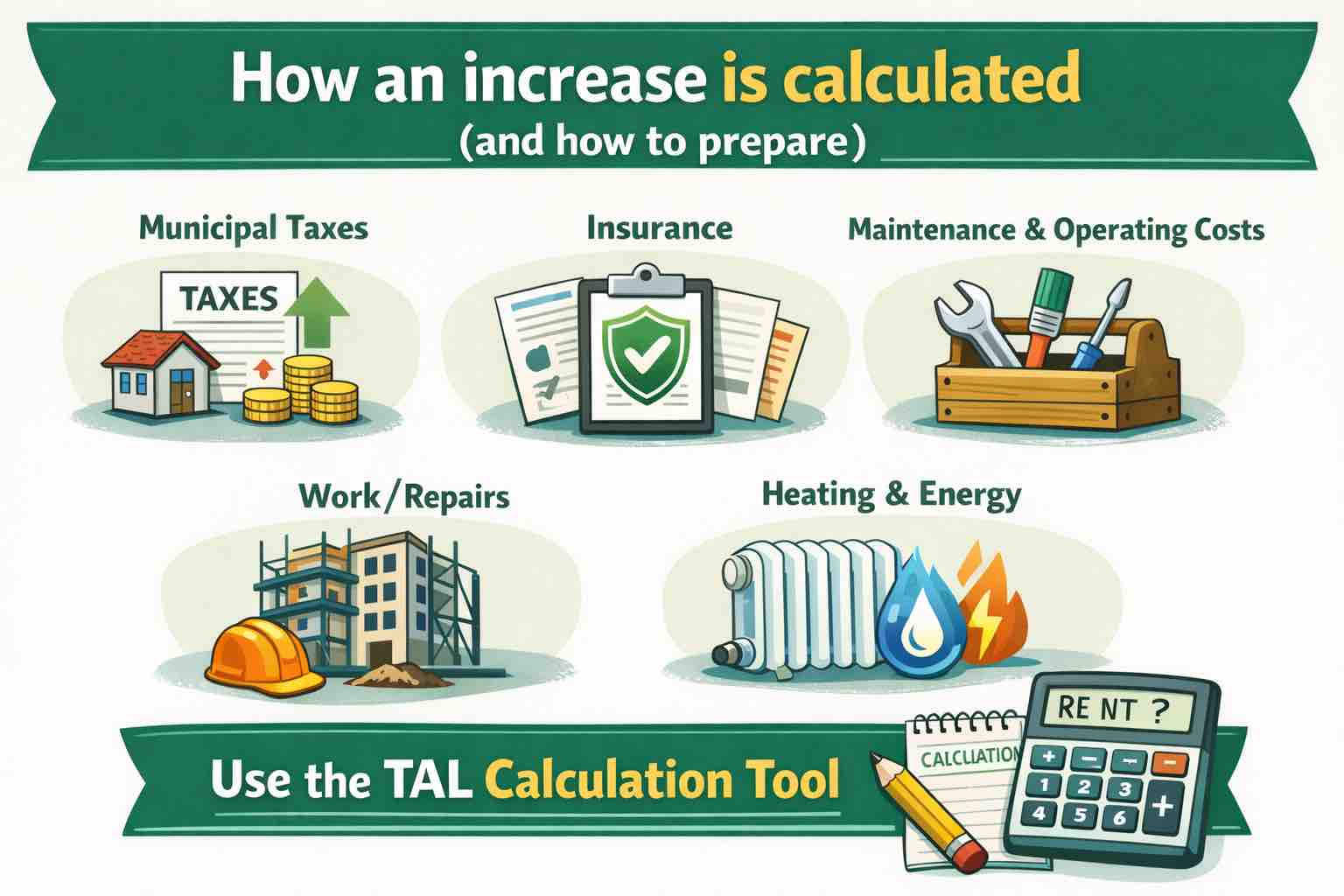
The confusion often comes from a common belief: “The TAL says it’s X% this year, so that’s the rule.” In reality, the published percentages are mainly a reference and a starting point, based on expenses like taxes, insurance, work performed, heating, and more. The TAL also provides tools and a method to help calculate a more accurate increase depending on each building’s situation.
The goal (in theory): a fair and reasonable increase
Whether you’re a tenant or a landlord, the point of a framework like the TAL’s is to make rent increases easier to understand and negotiate—based on real numbers (taxes, operating costs, maintenance, etc.). The TAL even offers a calculation tool to support discussions.
When you receive an increase, ask: “Did I get a proper written notice on time? Do I understand why it’s that amount?”
Those two questions alone clear up most situations.
When can a landlord increase the rent?
Generally, rent can’t be changed “at any time.” It’s usually adjusted at lease renewal, through a notice of change. In other words: an increase is normally tied to the renewal process, not a random mid-lease change.
Possible exceptions (depending on the situation)
There can be special situations (e.g., certain open-ended leases, specific agreements, added services, etc.), but the basic logic stays the same:
increase = rules + written notice + deadlines.
A “verbal increase” or a quick text message without respecting the rules and deadlines is exactly what creates avoidable conflicts.
Rent increase notice: deadlines, content, proof
The notice is the key piece. It must be written and sent within deadlines that vary depending on the lease length.
A good habit: always note the exact date the notice was received—because that’s what triggers your response timeline.
What should the notice include?
A proper notice should clearly state the intended change and allow the tenant to respond (accept / refuse / leave), with enough clarity to avoid misunderstandings.
A good, simple notice usually includes:
- The new rent amount and the effective date
- Any other lease changes (if applicable)
- A clear way to reply (accept / refuse / leave)
- Proof of delivery/receipt (very helpful if there’s a dispute)
Landlord: keep proof of sending and receiving (acknowledgement, confirmed email, etc.).
Tenant: write down the exact date you received the notice—deadlines start there.
What’s the maximum rent increase?
This is one of the most searched questions—and I get why. The simplest answer:
there isn’t one universal “maximum” that applies to every unit, every building, every city, every situation.
The TAL publishes applicable percentages and a calculation approach that help estimate a reasonable increase based on real expenses and the building’s profile.
Those references are used to support a fair calculation, not to impose a one-size-fits-all number.
So “maximum” depends on the file
If an increase looks excessive, the best approach isn’t to argue a “magic cap,” but to look at:
- Is the notice valid (deadlines, content)?
- Is the amount supported by real factors (taxes, insurance, work, etc.)?
- Can you negotiate?
- If there’s no agreement: will the TAL need to decide?
What is a “legal” rent increase?
People often ask: “What’s the legal rent increase this year?” Technically, what’s “legal” depends on respecting the rules
(notice, deadlines) and, if there’s disagreement, the TAL’s ability to set the rent.
You’ll often see a “reference average” discussed publicly (especially in the media). It’s useful context, but it’s not an automatic rule for every unit.
The actual result can vary based on the building’s expenses and situation.
A “headline percentage” is not automatically the right number for every apartment. Use it as context, not as a guaranteed outcome.
And for next year?
The TAL’s reference information is usually released in January (and it always gets attention). Best habit: check the official TAL publication for the year in question, instead of relying on rumours or viral posts.
How an increase is calculated (and how to prepare)
If you want something practical, the simplest starting point is the TAL tool. It’s designed to support negotiations and to estimate a fair increase (based on the information entered).
Official tool :
TAL rent setting / increase calculation tool
.
What often influences the calculation
- Municipal taxes (changes year to year)
- Insurance (often increasing lately)
- Maintenance and operating costs
- Work/repairs (depending on the type and the rules that apply)
- Heating & energy (included or not, cost changes, etc.)
Mini example (to visualize)
If you see an increase stated as “X%,” the best reflex is to ask:
“What’s driving that X? Taxes? Insurance? Work? Operating costs?”
You don’t need to be an expert—just having the why makes the conversation far more productive.
Refuse, negotiate, challenge: what to do in practice
Receiving a notice doesn’t mean you must automatically say yes. Tenants have options—and the most important thing is to respect the response deadline.
The 3 classic responses
- I accept the increase
- I refuse the increase but I stay in the unit
- I leave at the end of the lease
Before things get heated, try this: “Can you break down what explains the increase? Let’s talk.”
A lot of conflicts get resolved right there.
What if there’s no agreement?
If the tenant refuses and wants to stay, the landlord can apply to the TAL to have the rent set. The TAL can then decide based on the applicable criteria.
The Duranceau reform: what changes in the spirit of the rules
You’ve probably heard a lot about “new rules” around rent setting. The government has presented changes aimed at simplifying and clarifying the rent-setting method so the calculation is easier to understand.
In public discussions, many summaries mention a timeline around January 1, 2026, which is why searches for “new rent increase rules” have been trending lately.
Why it matters (even if you hate politics)
Because the calculation method affects:
- The yearly reference guidance everyone talks about
- Predictability (or not) of increases
- Negotiations between tenants and landlords
- Disputes and rent-setting decisions at the TAL
No matter the “formula,” what people want is clarity: understand what drives the increase, talk it through without drama, and have rules that feel predictable.
If reforms make it simpler to explain—without losing balance between both sides—that’s a win.
If you want a reliable, official-style reference on notices and procedure (without guessing), here’s a government resource :
Rent increase: when and how your landlord must notify you
Common mistakes (both sides) + quick tips
Tenant side 🙋♂️
- Waiting too long to respond (missing the deadline)
- Refusing verbally with no written proof
- Confusing “average reference” with “automatic rule”
- Not asking what’s behind the amount
Landlord side 🧾
- Sending the notice too late (invalid for that renewal period)
- Not keeping proof of sending/receiving
- Proposing an amount without a basic explanation
- Forgetting that tone + transparency change everything
A short conversation + a clear written recap (even 5 lines) beats 47 emotional messages.
Why this also affects the real estate market
We don’t always think about it, but rent increases and rent-setting rules directly affect:
- The profitability of income properties
- Renovation and maintenance decisions
- Landlord-tenant relationships (and stability)
- What investors are willing to pay (based on projected income)
If you’re a landlord (or future buyer) and you’re wondering what this means for your property value, a solid first step is getting an estimate.
You can use my tool:
Quick, free property evaluation
.
Want to reach me directly (no middleman)? Here’s my contact page :
Contact me
.
And if you want to understand another topic that often comes up for landlords, here’s my article on repossession of a dwelling :
Repossession of a dwelling: what you should know
.
Helpful federal resource: rent trends (Canada)
If you want a broader “Canada-wide” perspective (beyond Québec rules), CMHC publishes information on rent increases and the rental market.
Resource :
Rent increases (CMHC)
.
FAQ
Can a landlord increase the rent if I refuse?
A landlord can propose an increase. If you refuse and want to stay, the landlord can apply to the TAL to have the rent set. The TAL decides based on the applicable criteria.
If I don’t reply to the notice, what happens?
If you miss the deadline, the law may treat it as acceptance. That’s why the date you received the notice matters so much.
Can I negotiate the amount?
Yes—and honestly, it’s often the best route: ask for the reasons, compare to the market, and try to reach an agreement before it turns into a formal dispute.
Does the TAL “set” one percentage for everyone?
No. The TAL publishes references and a calculation method; the outcome can vary depending on the building’s expenses and situation.