The goal of this article is simple: to explain what is realistic, what is risky, what lenders usually look at, and what options may exist if you want to buy a property but feel blocked by the down payment.
Is it possible to buy a home with no down payment?
Yes, it can be possible in some situations, but it depends on how we define “no down payment.” In most cases, a buyer still needs a minimum down payment for the mortgage approval. The money can sometimes come from another source, such as a gift from family, a withdrawal from an RRSP, a government program, or another accepted financial strategy.
So when people say “buying with no down payment,” they often really mean: buying without using money already saved in a regular bank account. That distinction is important. A lender still wants to know where the funds are coming from, whether the money is borrowed, whether it is gifted, and whether the buyer can afford the monthly payments.
✅ Important point: buying with no personal cash saved does not mean buying without any financial verification. The lender will still analyze your income, credit, debt ratio, employment stability and the source of your funds.
If you are a first-time buyer, this can feel confusing. One article says it is possible. Another says it is impossible. The truth is somewhere in the middle: it is possible for some buyers, with the right structure, but it is not automatic.
Is a down payment mandatory when buying a house?
In Canada, a minimum down payment is generally required when you buy a property. According to the Government of Canada, the minimum down payment depends on the purchase price of the home. You can read the official explanation from the Financial Consumer Agency of Canada here: minimum down payment rules in Canada.
For many buyers, the minimum is often 5% of the purchase price for the first portion of the home’s value, but the exact amount can vary depending on the price, property type, lender criteria and mortgage insurance requirements.
| Situation | What it usually means |
|---|---|
| You have personal savings | The down payment comes directly from your own funds. |
| You receive a family gift | The lender may accept it if properly documented. |
| You use RRSP funds | The Home Buyers’ Plan may help eligible first-time buyers. |
| You borrow the down payment | Some lenders may consider it, but the new debt affects your borrowing capacity. |
The key thing to understand is that the down payment has to come from an acceptable source. If the source creates too much additional debt, the lender may refuse the file even if the purchase seems possible on paper.
What are the solutions to buy with little or no cash?
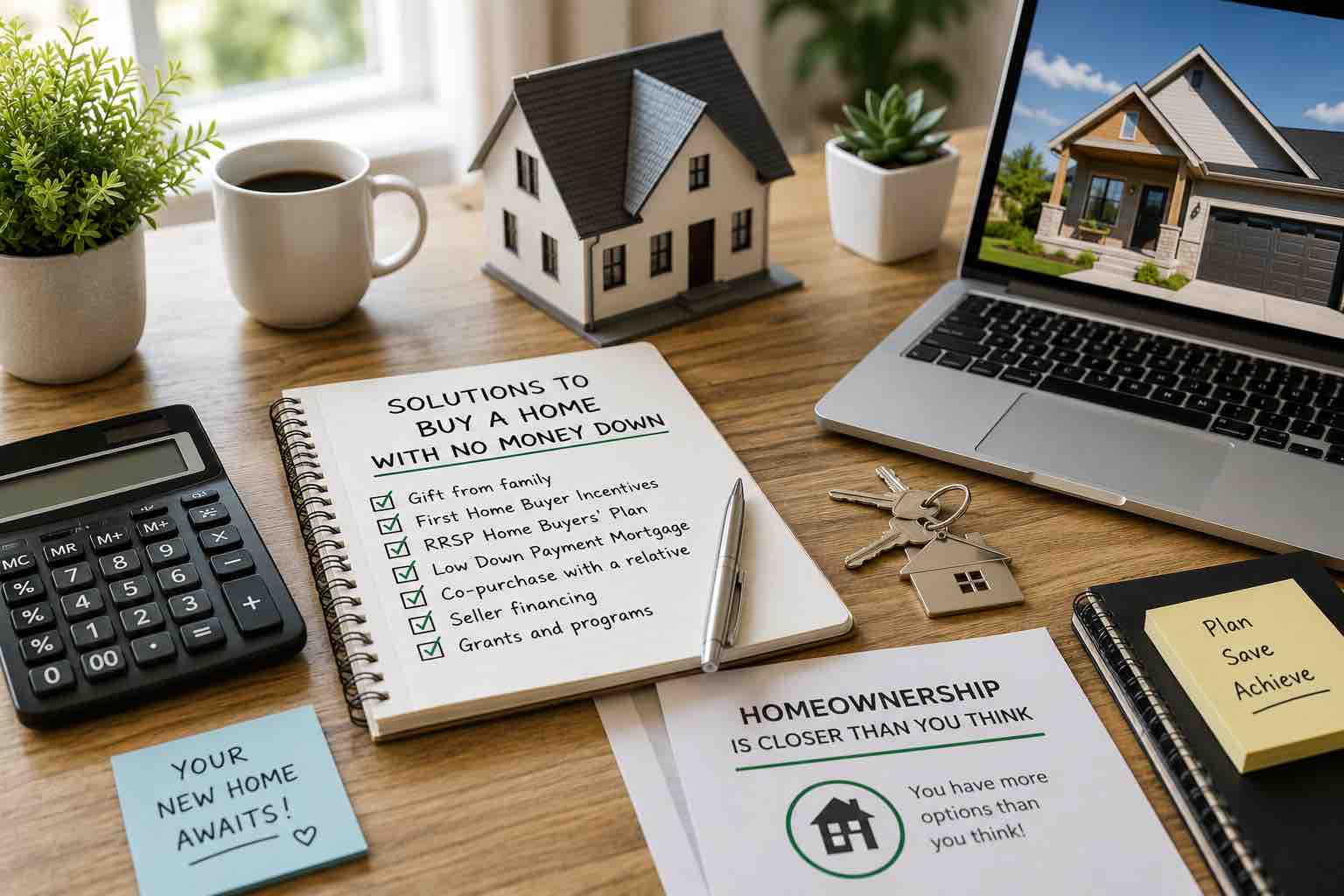
There is no magic formula, but there are several real strategies that may help depending on your situation. Some are simple, some require planning, and some should be used carefully. Here are the main options. 👇
1. Gift from family
A family gift is one of the most common ways to help a buyer purchase a first home. The money is not a loan. It is usually confirmed with a gift letter and proof of transfer.
2. RRSP Home Buyers’ Plan
Eligible buyers may use the Home Buyers’ Plan to withdraw from their RRSP to purchase a qualifying home. This can be a useful strategy if you already have RRSP savings.
3. First-time buyer programs
Some programs, rebates or incentives may reduce costs or help with accessibility. These programs change over time, so it is important to verify what applies to your situation.
4. Co-buying with someone
Buying with a spouse, parent, sibling or trusted partner can increase borrowing capacity, but it also creates legal and financial responsibilities for everyone involved.
5. Seller financing
In rare cases, a seller may agree to finance part of the transaction. This must be structured carefully with professionals, because it is not common and not always accepted by lenders.
6. Buying a less expensive property first
Sometimes the best strategy is not to buy the dream home immediately, but to enter the market with a more affordable property and build equity over time.
💡 My personal opinion: the best strategy is not always the one that gets you approved the fastest. It is the one that lets you buy without putting yourself under too much financial pressure after moving in.
If you are at the beginning of your buying process, you can also read more general guidance for buyers here: real estate buying advice in Quebec.
Can I buy a house with borrowed money for the down payment?
Sometimes, but this is where buyers need to be very careful. Borrowing money for a down payment can affect your debt ratio. Even if you can access the funds, the lender will calculate the monthly repayment into your overall affordability.
For example, if you take a personal loan to create the down payment, that loan does not disappear from the lender’s analysis. It becomes another monthly obligation. That can reduce the mortgage amount you qualify for, or even lead to a refusal.
⚠️ Be careful: using credit cards, personal loans or lines of credit to create a down payment can quickly become risky. You may qualify for the purchase but end up with very little breathing room afterward.
This is why it is important to speak with a mortgage professional before making a promise to purchase. The structure has to be realistic, transparent and acceptable to the lender.
Can family help me buy a home?
Yes. Family help is often one of the cleanest ways to support a purchase, especially for a first-time buyer. Parents or close relatives may provide a gift for the down payment, help with certain costs, or in some cases become co-borrowers.
A gifted down payment usually needs to be clearly documented. Lenders often ask for a gift letter stating that the money does not have to be repaid. They may also ask for proof that the funds were transferred.
Co-signing or co-buying is different. If a parent co-signs the mortgage, they are not just “helping emotionally.” They may become legally responsible if the payments are not made. This should never be taken lightly.
Can the RRSP Home Buyers’ Plan help with the down payment?
For eligible first-time buyers, the RRSP Home Buyers’ Plan can be a very useful tool. It allows you to withdraw funds from your RRSP to buy or build a qualifying home, under specific conditions.
This is not free money. The amount withdrawn generally has to be repaid to the RRSP over time. Still, it can help buyers access funds that are already theirs, rather than borrowing new money.
Éducaloi also explains different down payment options in Quebec in a clear way here: down payment options when buying a home.
🌱 Good to know: the RRSP strategy is often more powerful when planned in advance. Waiting until the last minute can limit your options.
What are the risks of buying without savings?
Buying a property is not only about getting the mortgage approved. There are also closing costs, moving costs, inspection fees, notary fees, adjustments, municipal taxes, welcome tax, insurance and sometimes unexpected repairs after moving in.
This is why buying with no cash cushion can be stressful. Even if the down payment is covered by a gift, program or RRSP withdrawal, you still need money for the rest of the transaction.
- ✅ Home inspection
- ✅ Notary fees
- ✅ Land transfer duties, often called welcome tax in Quebec
- ✅ Moving expenses
- ✅ Home insurance
- ✅ Immediate repairs or basic improvements
- ✅ Emergency fund after the purchase
As a real estate broker, I prefer seeing a buyer purchase a slightly less expensive home and keep some breathing room, rather than buy at the absolute maximum and feel trapped financially after moving in.
What do banks and mortgage lenders verify?
A mortgage lender does not only look at your down payment. The lender wants to know whether the full file makes sense. That includes your income, employment stability, credit history, existing debts, source of down payment and the type of property you want to buy.
Centris has also published helpful information about possible solutions for buying without a traditional down payment: solutions for buying a home with no down payment.
Here is what usually matters most:
- Credit score: late payments and high credit utilization can hurt your file.
- Income: stable income is usually easier to finance than irregular income.
- Debt ratio: car loans, credit cards and personal loans reduce borrowing power.
- Source of funds: the lender must understand where the down payment comes from.
- Property condition: a home with major issues can be harder to finance.
In other words, the question is not only “Do I have the down payment?” The real question is: Does the whole purchase make sense financially?
How to prepare before buying with little or no money down
If you want to buy a home but do not have much saved, the first step is not to visit ten houses. The first step is to build a clear plan. 🧭
Start with a mortgage pre-approval
A pre-approval helps you understand your real purchasing power. It also helps avoid disappointment, because you will know what price range makes sense before falling in love with a home.
Clarify the source of your down payment
Is the money coming from a gift, an RRSP withdrawal, a program, a sale of assets, or another source? The cleaner the explanation, the easier the file usually is to present.
Keep a reserve for closing costs
Even if the down payment is handled, you still need funds for the rest of the transaction. A good plan includes more than the purchase price.
Work with the right people
A good broker, mortgage specialist and notary can help you avoid costly mistakes. Buying with limited cash requires more planning, not less.
🏡 Thinking about buying soon?
If you are ready to start looking, you can fill out my real estate alert form and I can help you follow the right properties as they come on the market: create your real estate alert.
Is buying with no down payment a good idea?
It can be a good idea in certain cases, but not for everyone. If you have strong income, stable employment, low debts and access to a legitimate source of funds, the strategy may be realistic.
However, if you already have high debts, unstable income or no emergency fund, buying with no financial cushion can become heavy very quickly. A home is a great investment, but it also comes with repairs, responsibilities and unexpected expenses.
🚧 My advice: do not try to force a purchase just because you found a way to cover the down payment. The right purchase is the one you can live with comfortably after the keys are in your hand.
Final thoughts: myth or reality?
Buying a home with no down payment is not exactly a myth, but it is often misunderstood. You may not need to have all the money sitting in your chequing account, but the funds still need to come from somewhere acceptable.
The best strategy depends on your credit, income, debts, family situation, savings, RRSPs, goals and the type of property you want to buy. There is no universal answer, and that is why proper guidance matters.
If your dream is to become a homeowner, do not assume it is impossible just because you do not have a large amount saved today. But also do not jump too fast without understanding the numbers. The right plan can make a huge difference. 🔑
Frequently asked questions
Can I buy a home in Canada with no down payment?
In most cases, a down payment is required. However, the money may come from acceptable sources such as a family gift, RRSP withdrawal, program or other lender-approved strategy.
Is 5% always enough to buy a house?
Not always. The required down payment depends on the purchase price, property type, mortgage insurance rules and lender criteria.
Can my parents give me the down payment?
Yes, many lenders accept a gifted down payment from family, provided it is properly documented and does not have to be repaid.
Can I borrow my down payment?
Sometimes, but the new debt will usually be included in your debt ratio and may reduce your mortgage approval amount.
Should I buy if I have no emergency fund?
It is possible, but it can be risky. Homeownership comes with extra costs, so having a financial cushion is strongly recommended.